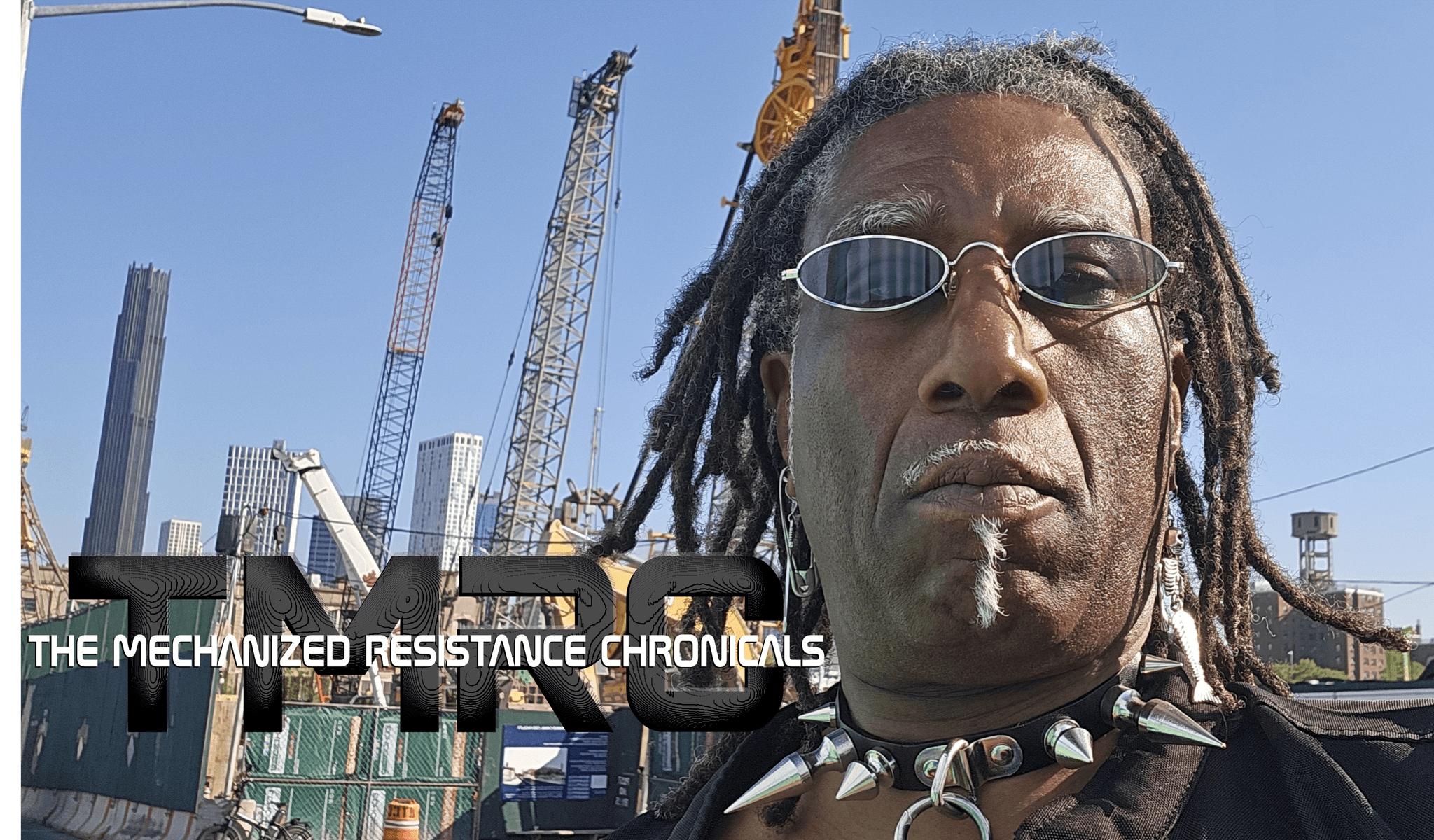
The Mechanized Resistance Chronicles
The 50th anniversary of Throbbing Gristle and Industrial Records is here!!! As sektor 6 kommunikations™ has planned for this milestone, we were seeking a way to honor this moment in the genre's evolution. Approximately 25 years ago, I spent a number of days chilling with Genesis P-Orridge to go deep into what influenced the founding of what became "industrial" from their perspective, and how COUM Transmissions came to be, which preceded the founding of Industrial Records, in addition to providing the first big show for Throbbing Gristle. Because I have dedicated my creative life to this artform at 21 years old, having already dedicated my life to a non-mainstream eclectic existence by the age of 10 [in 1974], our time together had the feeling of engaging the oracle. Truth be told, when we had the final event, which was part of the original HellLab series on 42nd St. in the heart of Times Square, Gen's manager came at us with a bunch of crazy. That was upsetting because of how much went into that event… including having it catered on top of fulfilling everything in the rider. That sadly fits some of the things Cosey said about Gen. I say that because it is important to be 100% real about how things went/go down. However, that final event didn't taint how I felt/feel honored to have been given a multi-day guided tour through Gen's life and meticulously stored archives, the laughs, discoveries, and chats while hanging with Gen and Lady Jaye, how dope it was to do the other events I produced with Gen, nor our personal discussions. As Ella Baker so rightfully said about the American way of life, "...it contaminates a lot of people." The same can be said about the entertainment industry's grasp on how people imagine art to be, in addition to how it should be presented and/or engaged. Many of Gen's enthusiasts received a bunch of amazingly rare and pristine collectables from the founding of this genre's namesake [fliers TG's original show, posters, various COUM and TG fliers and literature, stickers, ect] that were distributed during our events, which was something that I had requested, and Gen readily agreed, when we were considering the options of what would happen to our sizable archives. The looks on people's faces as they got these materials were awesome.
And our breaking story… Hell decides to use Ai for the first time in his writing!! WHAT?!?!?! [LOL!!] There is a madness to my method. ;) Anyway, while writing this I gave the prompt, "On this 50th anniversary of Industrial Records, we return to its original 1976 founding principles to project into the future." I only did it to see what it would say. [note: since people can get different answers depending on numerous factors, search it yourself to see what you get.] To my surprise, even Ai understands that the movement needs a new revolution, basically providing a strong seconding for what we have been propagating since the early 1990s when I saw and wrote about what I saw as a growing issue at the time. The Ai response was, "Celebrating the 50th anniversary of Industrial Records (founded 1976 by Throbbing Gristle) involves revisiting its core ethos—experimental, noise-driven, anti-commercial art/music for "Industrial People"—and applying it to today's digital age, likely meaning embracing radical DIY, confronting modern societal control, and pushing sonic boundaries using new tech, much like TG did with tape loops and performance art in the 70s, demanding authentic disruption..." Check. Check. And… motherfucking check. As Gen said, "We wanted to take out the rock and rock, and see what's left." This unhyphenated industrial scene removes the rock and roll, and is a community where everyone is encouraged to push their own boundaries in addition to the artform. Not to see how pop they can make it and still refer to it as being representative of the artform. But to fully realize its possibilities through one's own eyes. But getting the sound and vibe of rock and roll out of industrial is our first order of business. "As far as the scene goes, it seems to have devolved into more of a metal vibe, for the most part. All of the stuff that I loved about industrial music that came out of Genesis, with industrial records, or even going back to Stockhausen, all of that kind of, just freedom to do whatever with whatever. That's the thing that's missing in industrial music." Nivek Ogre [Skinny Puppy]
To that very point, sektor 6 kommunikations™ is providing the platform for that to be realized. "We call for an Industrialist movement that breaks free from the genre constraints of having a prefix [i.e. goth-industrial, metal-industrial, ect.], and returns to the core principles of Industrial Records' 1976 founding: pro-experimental, multi-gendered, anti-mainstream, anti-conservative, anti-absuive, multi-ethnic, and 100% anti-xenophobic."
We will use the FB Group "Industrial Culture For Industrialists" as a global gathering place. [FYI - All argument based posts will be deleted. This is a 100% no drama zone. If someone isn't down with the culture, they have no business here. All trolls and/or pop related promotional posts will be deleted & blocked. This is to promote, support, encourage, and share unadulterated industrial art and culture.]
Our vision is to provide strategic support [event production information & strategic advice] for those who want to create industrial microscenes wherever they are, but may not know how. Of course, we ultimately want to promote whatever comes our way. But, we also offer help to ensure that no one gets left out. You should know that there are always places for you to enjoy, create, and engage industrial music & culture that you can have complete control over. Find a space in the woods, a house/basement/backyard, loft, barn, warehouse, accessible public space, ect, and make shit happen. AND… you don't need to have a super-loud sound system! [Just like I didn't need the exclamation point. LOL!!!!] There are many sound set-ups that you can use that will be more than sonicly engulfing enough to groove, dance, and vibe to. Remember, the microscenes of the hip hop movement were experienced IRL with boom boxes. [My new portable sound system is louder and clearer than any boom box I had or heard. More on that later.]
We are happy to help anyone who wants to have the amazing feeling of being the person and/or group who made interesting industrial art happen in their region for the first time. A microscene is 3 to 50 people. To quote the venerable activist goddess of the 60s Black Freedom movement, Fannie Lou Hamer, "There is one thing you have got to learn about our movement. Three people are better than no people." Getting together in any form is a worthwhile effort. Never believe that if there aren't hundreds of screaming people partying with you, it is a "lame party." All subcultures exist in low-density situations. It was all our small shows [microscenes] of the late 1970s/early 1980s punk scene that made the formal venue shows so epic. There are also venues that are in the middle. In NYC, that would have been the punk club A7. Playing there was so dope because it was the ultimate really small hole-in-the-wall venue. The point is that we had devised a way to have control over our scene that over the years the combination of venues, promoter/DJs, and the industry have all but removed. Having personally lived it as an artist and an enthusiast, I know what has been lost. Even the common practice of local acts being on national and international shows was removed by scum like Live Nation that provide an end-to-end "flywheel" model of control and monetary exploitation.
The same can be said for the industrial scene in the mid 1980s. There were no celebrities of the artform, so our whole scene was overwhelmingly performing in venues that held 800 capacity and down for the large shows, and 200 and down for the majority of shows, with most microscene shows having an average of 20 to 75 attendees. The point was to show how small venues, and situations, can often be an exception to any rule when seeking the opportunity to produce/present eclectic art. Access to them for industrial events, or any type of event for that matter, is solely based on that unique situation. [Note: The management in small venues can be more flexible in what they will host. A strong proposal could make the difference. In addition, any small venue that you attend on a regular basis and have a good relationship with the staff can be a possible location. More about this later.] Clubs should only represent a portion of where industrial is found, because the truth is that formal venues are honestly not capable of, nor interested in, supporting an unhyphenated industrial movement.
Your region, wherever you are, will produce a unique style and vibe based on whatever your resource base is, which is the beauty of the artform. For me it was growing up where there were a bunch of accessible decommissioned military bases, I grew up using various tools [powered and manual], and I had a love for non-traditional compositional styles. My love of the compositional styles of Parliament Funkadelic in 1972 when I was 8 years old was the first to put me on the path of social eclecticism through musical performance. They would remain a fave band as I developed an equal love of new wave/punk. When you see someone do something that seems to be original to you, use that energy to innovate yourself, versus simply copying their innovations. The further you see others go into their heads should inspire you to go even deeper into yours. Also, and this is important, have no concern that most of your friends won't like what you create. As a 1st gen punk rocker, that reality was the norm… and we took great pride in it. People who know you will buy your art because they know you. In my case, Mutha Records was the first punk label on the Jersey Shore, and the PD™ album was the third release on the label, which made it a novelty purchase for our friends, although most of the people I grew up with hated punk rock, especially hardcore punk, no matter who wrote it. If the only industrial music in your friend's collection is your music, they have it because they like you, not the artform. Industrial is about hyper-self expression, as was punk rock… and neither were motivated by trying to be liked by the mainstream [i.e. everyone]. Be motivated to do what you do no matter who likes it.
To the previous point.. Start making your own industrial art!!! In the NYC, New Jersey, Pennsylvania region, from the 1980s to the early 1990s, the majority of the industrial events featured local bands on their primary nights. I loved performing with that network of events, producers, promoters, and artists, and miss the comradery of that scene. The goal for this is that new artists come out of [y]our microscenes who have developed [y]our own presentational style and sound. Far too many artists have been told by "industry experts" to keep their performance rigs small to conform to the limitations of formal club/venue presentational formulas. The only thing that shields me from that is my determination to be enabled to do what I do, or it's not happening, which is why I only choose amenable situations. Young artists often feel they have no choice but to take whatever is offered to them. Not to forget, they have also been told to basically replicate whatever hybrid style of industrial was/is popular at that time. We fully reject that. Over 45 years ago, we created a vibrant punk microscene on the Jersey Shore that functioned outside of the formal industry. It is easier to create microscenes than any time in human history. Create the largest thing your ideas and resources [human first & monetary second] will enable. If it can only happen in one location because of its size or resources, bring people to see your performance on site. EVERYWHERE can be a performance space… if you are strategic enough, and fervently want it to be.
The Grateful Dead's model, which was originally reviled by most industry experts, still ended up being one of the most financially successful band models in history, which is but one of a villion examples of experts being wrong. The Dead never would/could have guessed what the future had in store for them when they were originally performing at happenings, loft parties, and the legendary free parties in Golden Gate Park. [FYI - The Dead were responsible for a number of innovations including creating one of the most unique audio experiences EVER that was called "The Wall of Sound."] It was simply their dedication to doing it, and having a receptive group of hardcore members dedicated to engaging it. I only say that because being dedicated to doing things differently than the experts would advise doesn't mean that your model won't catch on. The foundational point is to have a model that is so dope to you and/or your microscene that if no one else ever engaged your productions, that would be more than fine, and your only thought would be like ours was back in the day, "...too bad they fucking missed it." That way, no matter the level of broader success your microscene has in attracting others, you will have created endless adventures that you will remember for the rest of your life. I certainly have extremely fond memories of the many, many, many DIY microscene events I have produced, performed at, and attended since the late 1970s.
The Industrialist Production Manifesto
We are providing a roadmap for those who may not be familiar with producing microscene events, and possibly provide guidance for those who are experienced event producers who want to expand to producing microscene events outside of formal music venues.
- Let's be 100% clear… This IS NOT a "we know what's best" influencer production manual. It is only to provide additional guidance for those who would benefit from it, and to introduce more people to this model.
- This isn't an artform/genre that you will make enough money to live on. Period. Only a rare few make enough money on their music alone, and I am talking about the people you see on stages with your favorite celebrity bands. Do it because you are driven to do it. I have had a life-long art career without all the industry shit because I never expected it to support me. I only wanted to make an impact and to have it pay for itself, which has luckily happened in both cases. A rare few of the artists who are considered celebrity bands make enough money to provide a proper living wage for all the creators/performers, paying themselves for the time and resources that go into having a traditional band utilizing the commonly sought after touring model.
- If you see a small venue that has a happy hour 7-days a week, and you see there are days, or even a day, where they only have 5 people sitting at the bar. That is a target location.
- Sports bars can be great targets for video heavy event ideas. Not every sports bar is run by jerks, making them a possibility, although most have management and regulars that are hostile to our culture. The artform is in finding the gem. Always be on the lookout.
- Anywhere is a place for a microscene happening. [FYI - A "happening" is an event term that was used in the 1960s during the psychedelic rock movement that used lofts, apartments, and public spaces to have gatherings. It is what we called "outlaw parties" in the 1970s and 1980s.] The point is to scale your events to your resource base, as previously stated. The vibe of chill microscene events, especially when we were going nuts skanking to whatever hardcore punk in the late 70s/early 80s in a bedroom, rehearsal space, or living room, resonates to this very day. It should be said that gatherings are considered "chill" because you can be in a space where there are no concerns about negative social, emotional, verbal, or physical aggression of any kind. Small gatherings enable you to know everyone that is there. No one gets lost in the crowd… because there isn't one.
- If you are a person who always seems to hear about industrial bands, events, or whatever before your friends, that means you already have a microscene. It is just bringing those people together in a more focused way, realizing the social cohesion you have already developed around this artform.
- Microscenes enable the ultimate control over how you engage industrial culture. Maybe your region doesn't have any place that is suitable to have bands perform. That means you can focus on gatherings where you can check out, and possibly dance to, sonic and visual industrial art. Have screening parties where you watch new music/concert YouTube videos, which can happen wherever you have a computer or internet capable TV.
- Making music events happen without bands is easier, AND IT IS A TRAP! Make every effort possible to create your own sonic and visual industrial art using whatever you have access to. Take the wonderful compositional power of being able to be free of the tyrannical lock that notes, formal instruments, and chords have on the imaginations of most composers. This is an artform where the rhythmic pulse created by a circular saw cutting through wood with a metal blade put on backwards, recorded and slowed down, becomes a groovefest of sounds and textures to sample from, being representative of one of many layered "instruments" that function as components of the overall composition. There is no mandate to use a synth or any traditional gear whatsoever. [One of my recent tracks used a bus running over a loose large metal construction cover plate as a bass drum.] Although the mentioned model is a combination of field recording and studio-based production, we are by no means telling you to forgo getting together with your friends and generating sound, in whatever way you can, in real time. It is just important to remember and remind others, as well as ourselves, the power every individual has to create. Never wait until someone else agrees with your idea[s] before you do something. Do whatever you are driven to do and you will create the energy where others can vibe with you.
- For those interested in doing events in areas with no AC power [beach, woods, under a bridge, in an abandoned building, ect.], there is a go to system. The Mackie Go audio mixer is a digital equivalent to the Mackie 1202, except it has on-board effects, a Bluetooth input channel, AND… it has a rechargeable [USB] battery that is swappable and lasts 7 hours! I use that with a pair of Roland EX Street Cube speakers. [FYI - This is the busker speaker of choice, and they typically only use one, taking advantage of the on-board mixer. Each speaker runs on 8 - AA batteries for a crazy 10 hours!] Using a pair of the Cubes, and running them with the Mackie Go as a stereo system, will give you all the sound reinforcement you need for many types of events. [note: ultimately I have plans for 4 - Cubes in my system, but a stereo configuration will 100% be enough.]
- Need extra help? If you always wanted to do something and didn't know how, or are unsure about what productions are possible in your region ["region" is defined as being within 20 minutes from your home], DM us your zip code and we would be happy to help you make something happen. We have over 50 years of experience in developing and being part of microscenes, and thrive on assisting others.
There is a lot more to say, and we will be doing that via our video series. Our goal here is to provide motivation and a starter production model for those who may require one to move their ideas to the next level. We are now fully realizing the possibilities of our artform. The technology has come about at the right time. If you are in the NYC region, sektor 6 kommunikations™ will be producing "Sonic Invasions" that will happen throughout the city. If you are interested in participating, we would love to have you.
"You never change things by fighting the existing reality. To change something, build a new model that makes the existing model obsolete." Buckminster Fuller
Let's do this.
Peaceness and Sledgehammers,
dh